What Is Adult Day Care? A Complete Guide for Families
KP
By Kasper PollasFounder, Adult Day Care Centers Directory
Share this guide:
Key Takeaways
Adult day care provides supervised daytime programs—meals, activities, health monitoring, personal care—for adults who need support but live at home
At a median cost of $100/day ($26,000/year), it's the most affordable long-term care option—less than half the cost of assisted living
Medicare does NOT cover adult day care (a common misconception), but Medicaid waivers cover it in most states
Research shows caregivers experience significantly less stress on days their loved one attends—this isn't just "a break," it measurably protects your health
If your parent resists the idea, you're not alone—and initial resistance often gives way to genuine enjoyment within weeks
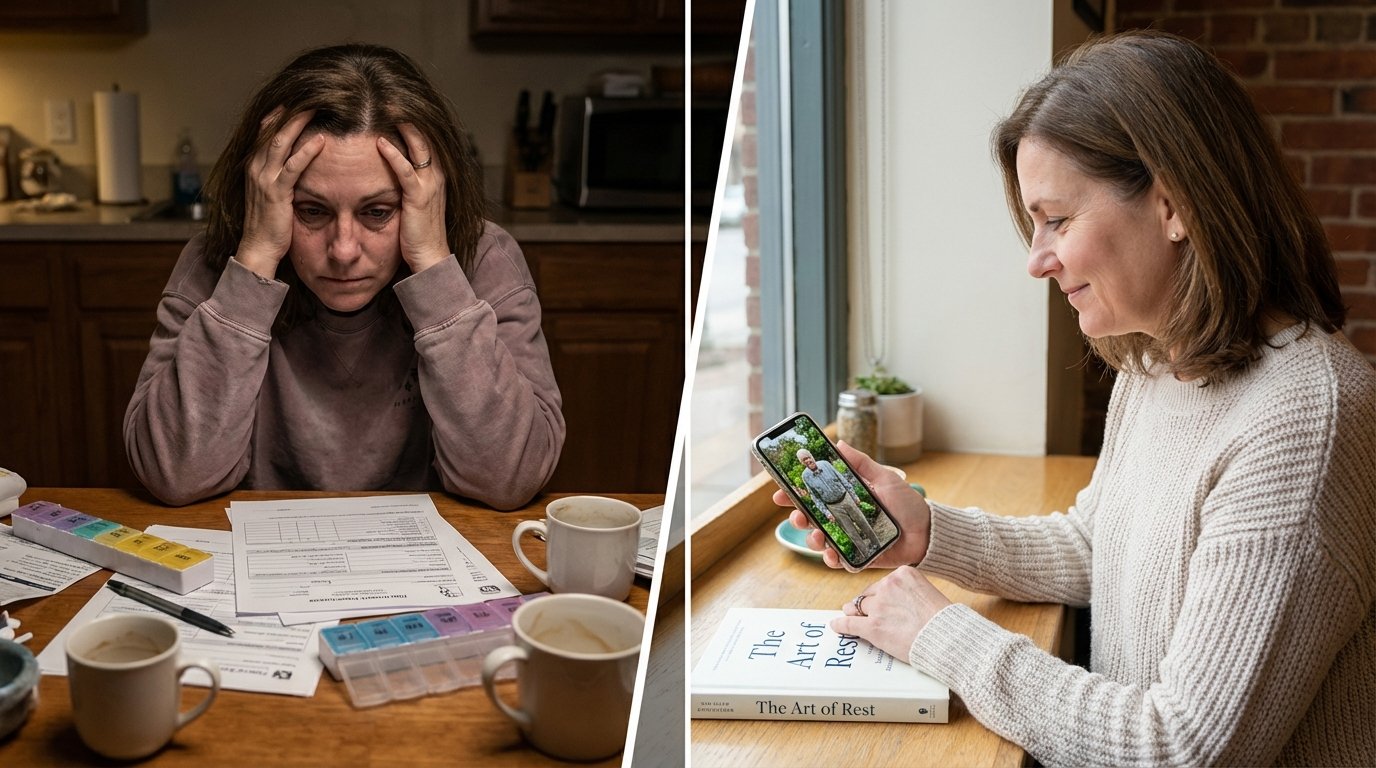
If you're reading this, chances are you're exhausted. You may be juggling work and caregiving, watching your parent decline, or lying awake wondering how long you can keep this up. You might feel guilty for even searching "adult day care"—like considering it means you're giving up or failing somehow.
You're not failing. And you're not alone.
In caregiver forums, one theme appears again and again: guilt. Phrases like "Am I a bad daughter/son/husband/wife for even thinking about this?" are very common, and many families describe feeling like "prisoners in their own home" trapped between their loved one's needs and their own survival.
This guide exists because navigating adult day care is confusing, the information online is scattered, and nobody should have to figure this out while running on empty. We've done the research—dug through government data, academic studies, and hundreds of real caregiver discussions—so you don't have to piece it together yourself.
Here's what you need to know.
What Is Adult Day Care, Exactly?
Adult day care is a supervised program where your parent (or spouse, or loved one) spends the daytime hours—typically 4 to 8 hours—in a community setting with trained staff and other participants. They get meals, activities, social interaction, and depending on the program, health monitoring and personal care assistance. Then they come home in the evening.
Think of it as the middle ground between "they can't be alone all day" and "they need to move to a facility."
The official definition from the National Adult Day Services Association describes it as "professionally delivered, integrated, home- and community-based, therapeutic, social and health-related services provided to individuals to sustain living within the community."
Translation: structured daytime support that helps people stay living at home longer.
There are currently about 5,135 adult day centers across the United States, serving roughly 182,000 people on any given day. That number dropped during COVID but has largely recovered.
Adult Day Care in the United States
Metric
Current Data
Total centers nationwide
5,135
Adults served daily
182,000
For-profit ownership
57%
Participants with dementia
34%
Average attendance
3-5 days per week
Source: CDC National Post-acute and Long-term Care Study, 2022
The Three Types of Adult Day Care
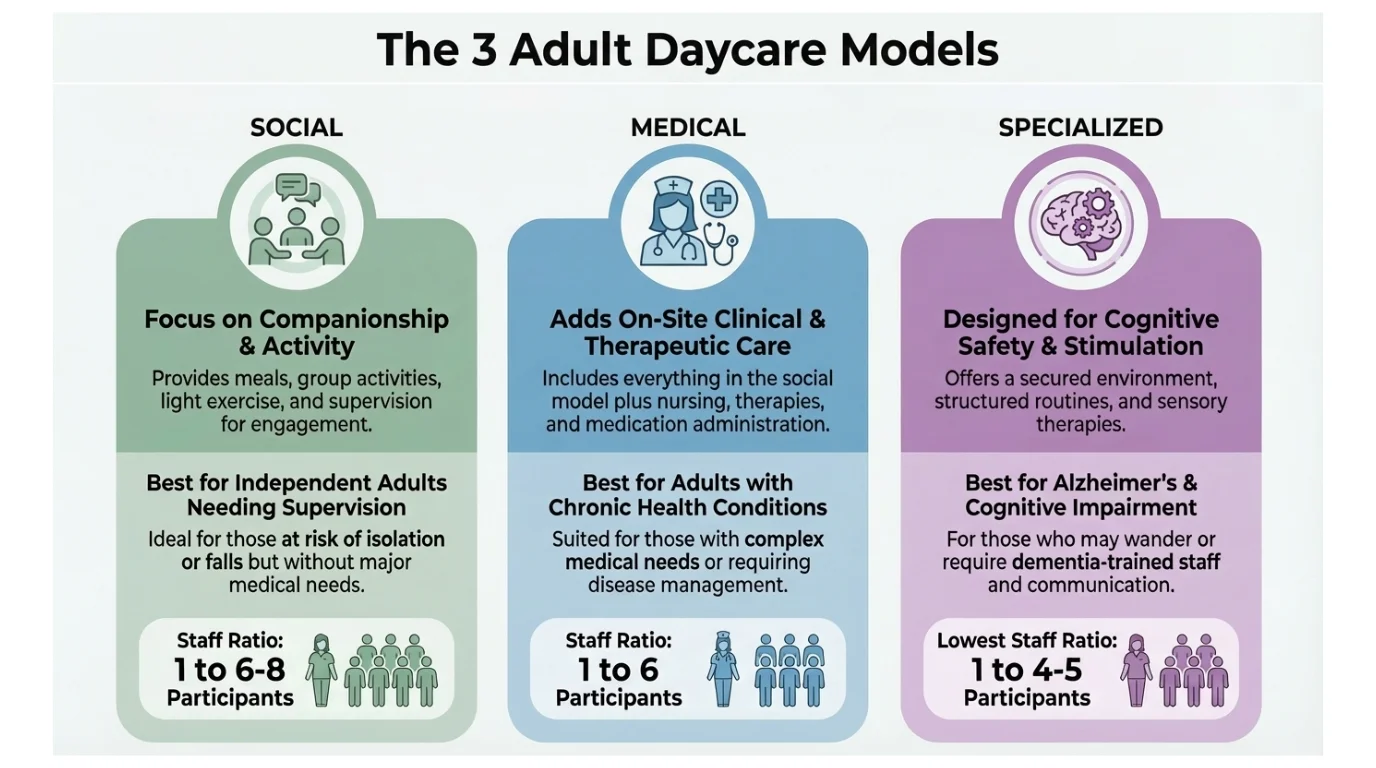
Not all programs are the same, and the distinction matters—both for what your loved one will experience and what funding might cover.
Social Model: Activities and Companionship
Social model programs focus on engagement, not medical care. They're designed for people who are reasonably independent with personal care but shouldn't be alone all day—whether because of fall risk, early cognitive changes, or simply isolation.
What you'll find: Meals and snacks. Group activities (crafts, games, music, discussions). Light exercise programs. Medication reminders—though typically not administration. Transportation in many cases.
Who it's for: Someone who's lonely, bored, or at risk unsupervised, but doesn't need nursing-level care.
About 16% of centers are purely social; another 31% lean social with some health services mixed in.
Medical Model: Nursing and Therapy Included
Medical model programs—often called Adult Day Health Care—add clinical services on top of the social programming.
What you'll find: Everything above, plus on-site nursing (RN or LPN), medication administration, vital signs monitoring, wound care, physical/occupational/speech therapy, personal care assistance (bathing, toileting, transfers), and coordination with physicians.
Who it's for: Someone with multiple chronic conditions, complex medication regimens, or care needs that might otherwise require nursing home placement.
About 40% of centers handle both social and medical needs equally. Another 13% focus primarily on medical care.
Specialized Dementia Programs
Some centers specialize in memory care—serving people with Alzheimer's and other dementias in secured environments with specially trained staff.
What's different: Lower staff ratios (often 1:4 instead of 1:6 or 1:8). Secured spaces for those who wander. Staff trained in dementia communication and behavior management. Programming designed around cognitive impairment—reminiscence activities, structured routines, sensory experiences.
In centers with specialized dementia care, about 42% of participants have Alzheimer's or another dementia, compared to 23% at centers without specialized programs.
If your loved one has dementia, ask specifically about dementia training, secured areas, and staff-to-participant ratios. Not all centers that accept people with dementia are truly equipped to serve them well.
What Actually Happens There All Day?
A reasonable question—and one many families hesitate to ask, worried it's just "warehousing."
Typical Daily Schedule
8:00-9:30 AMArrival. Coffee and socializing. Breakfast for early arrivals. Staff check in with each participant.
9:30-11:30 AMGroup activity—maybe chair exercise, a craft project, a music program, or a discussion group. Health checks for those who need monitoring.
11:30 AM-12:30 PMA hot meal. Special diets (diabetic, low-sodium, pureed) are typically accommodated.
12:30-2:30 PMRest time for those who need it. Quieter activities. Individual therapies if it's a medical model program.
2:30-4:00 PMAnother group activity. Snack. Preparation for departure.
3:00-4:30 PMTransportation home or family pickup.
The specifics vary. Some programs run shorter (4-5 hours), some longer. Some focus heavily on outings—trips to parks, museums, restaurants. Others emphasize on-site programming. The best programs balance structure with flexibility, adjusting to what each participant needs that day.
What's Usually Included in the Daily Rate
Supervision and safety monitoring
Meals (lunch plus snacks; some include breakfast)
Social and recreational activities
Basic health monitoring
Personal care assistance as needed
Cognitive stimulation programming
What Often Costs Extra
Transportation ($10-25/day at centers that charge separately)
Specialized therapy (PT, OT, speech)
Personal care supplies
Extended hours beyond the standard program
Always ask for a complete breakdown before enrolling. The "$100/day" headline number doesn't always include everything.
Costs went up about 5% from 2023 to 2024, roughly tracking inflation.
The Comparison That Matters
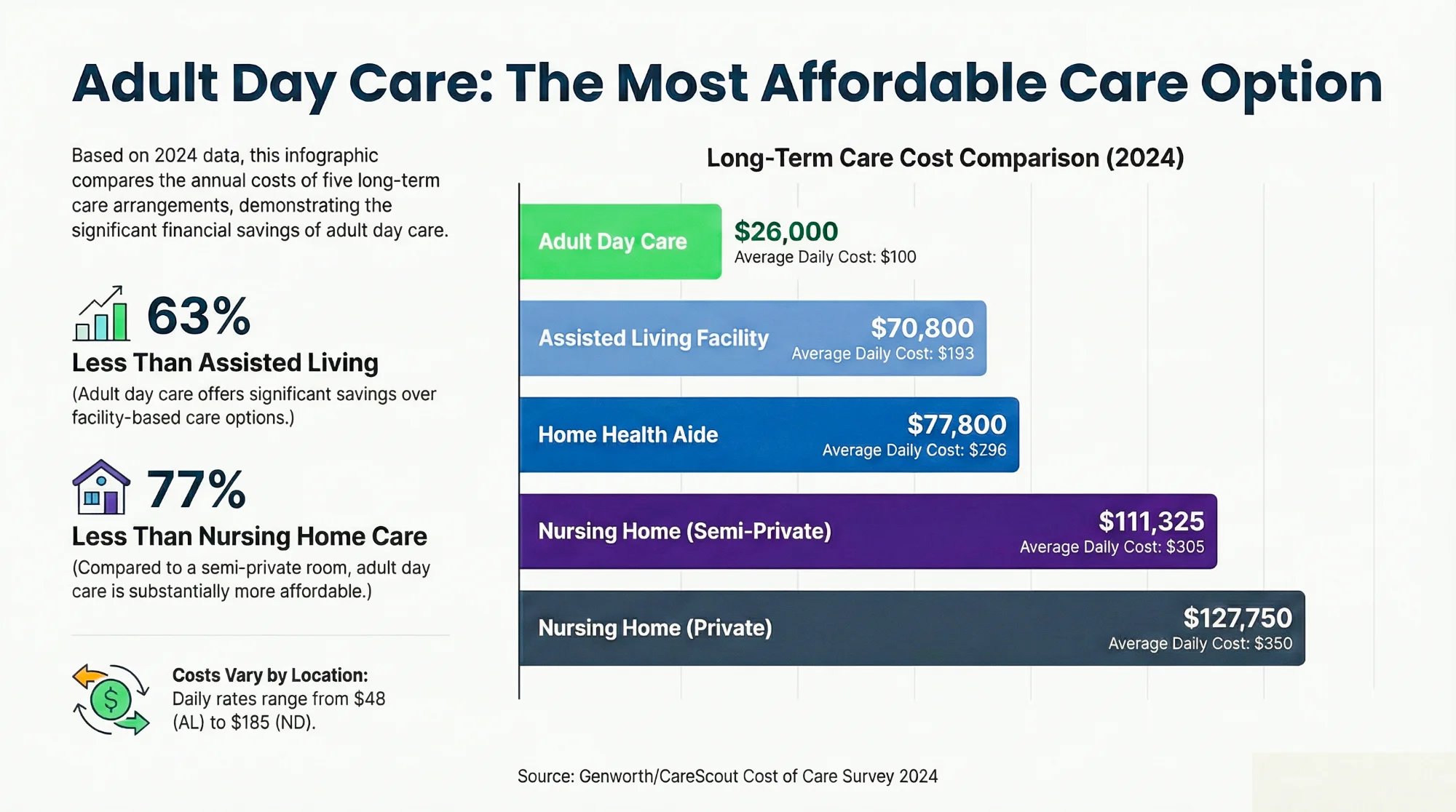
Adult day care is the most affordable supervised care option—by a significant margin.
Care Type
Daily Cost
Annual Cost
Adult Day Care
$100
$26,000
Assisted Living
$193
$70,800
Home Health Aide (8 hours)
$296
$77,800
Nursing Home (semi-private)
$305
$111,325
Nursing Home (private)
$350
$127,750
Adult day care costs $26,000/year—63% less than assisted living ($70,800) and 77% less than nursing home care ($111,325).
For families where someone needs supervision during work hours but doesn't need 24-hour residential care, adult day care is often the most sustainable financial option.
It Varies by Location
Costs range dramatically depending on where you live:
Highest: North Dakota averages $185/day; Northeast and West Coast states often run $130-180/day
Lowest: Alabama averages $48/day; many Southern states fall in the $60-80/day range
Your local Area Agency on Aging can help you understand costs in your specific area.
Does Medicare Cover Adult Day Care?
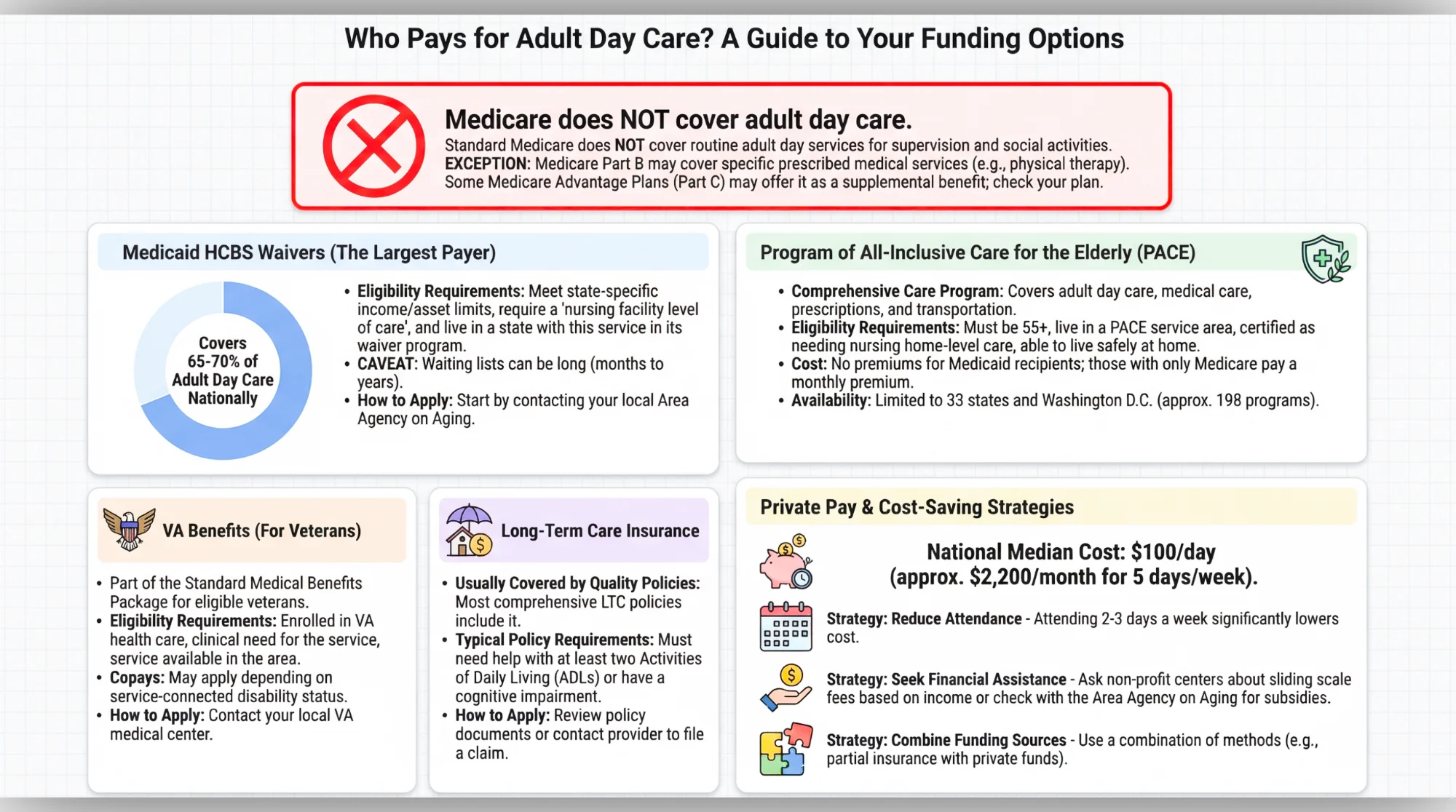
No. Medicare does not cover adult day care.
This is the single most common misconception families encounter—and one of the most frustrating. Medicare.gov explicitly states that Medicare doesn't pay for long-term care, including adult day health care.
Medicare covers medical treatment and short-term rehabilitation. It doesn't cover ongoing supervision, custodial care, or help with daily activities—which is what adult day care primarily provides.
A common frustration in online caregiver communities: families don't discover this until after they've already started researching programs.
The Fine Print Exceptions
Medicare Part B may cover specific medical services (like physical therapy) delivered at an adult day center—if prescribed by a physician and meeting Medicare's requirements. But this covers the individual therapy session, not the day program.
Medicare Advantage (Part C) plans sometimes include adult day care as supplemental benefits. This isn't guaranteed and varies by plan. If you have Medicare Advantage, call your plan directly and ask specifically about "adult day services" coverage.
What DOES Pay for Adult Day Care
While Medicare is out, several other options exist.
Medicaid Waiver Programs
Medicaid is actually the largest payer for adult day services—covering roughly 65-70% of all adult day care costs nationally.
Income and assets below your state's Medicaid limits
A "nursing facility level of care" (meaning you'd otherwise qualify for nursing home placement)
A waiver program that includes adult day services (most states have one)
The catch: these aren't entitlements. Many states have waiting lists—sometimes months, sometimes years. Contact your local Area Agency on Aging to understand options and timelines in your state.
Your state certifies you need nursing home-level care
You can live safely in the community with PACE support
For those who qualify, PACE covers nearly everything—medical care, adult day services, prescriptions, transportation—with no deductibles or copays for covered services.
Requirements: Enrolled in VA health care + clinical need for the service + availability in your area.
Copays may apply depending on service-connected disability status. Contact your local VA medical center to ask about eligibility.
Long-Term Care Insurance
Most quality long-term care insurance policies cover adult day care. Dig out the policy and check, or call the insurer directly. Coverage typically requires documentation that your loved one needs help with at least two daily activities or has significant cognitive impairment.
Private Pay (and Ways to Reduce It)
Families without Medicaid, PACE, VA, or insurance coverage pay out of pocket. Some strategies:
Reduce the schedule: 2-3 days/week instead of 5 significantly lowers monthly costs
Ask about sliding scale fees: Some nonprofit centers adjust rates based on ability to pay
Combine funding: Use partial VA benefits plus private pay, for example
Check local programs: Some Area Agencies on Aging offer subsidies
Who Is Adult Day Care For?
The stereotype is elderly people with dementia. The reality is broader.
32-39% of participants are under 65—often adults with developmental disabilities or younger people with early-onset conditions
58% are women, 42% men
34% have Alzheimer's or another dementia—which means 66% don't
Most participants have multiple chronic conditions (high blood pressure, diabetes, heart disease)
The majority need help with several daily activities (bathing, dressing, toileting, mobility)
Adult day care serves adults with intellectual disabilities, people recovering from stroke, those with Parkinson's, people with mental health conditions, and older adults who simply can't safely be alone all day.
When It Works Well
Adult day care is often a good fit when:
Your loved one can't safely be alone during the day
You need to work or need regular respite
They would benefit from social interaction and structured activities
You want to delay or avoid residential placement
They can participate in a group setting (even with significant assistance)
When It Might Not Work
Adult day care generally isn't appropriate when:
24-hour skilled nursing care is required
Behavioral issues (severe aggression, unsafe wandering) can't be managed in a group setting
Medical needs exceed what the center can handle
The person is completely bedbound
Residential care is truly necessary
What the Research Actually Shows
Beyond the practical benefits, there's solid research on what adult day care does for participants and caregivers.
For Caregivers: Measurable Stress Reduction
The most rigorous study comes from Penn State's Daily Stress and Health (DaSH) Study, which followed 173 family caregivers of people with dementia.
What they found:
Caregivers experienced 66% less exposure to dementia-related behavioral symptoms on days their loved one attended adult day care
On program days, caregivers got about 7 hours of respite—compared to less than 2 hours on non-program days
Caregivers reported lower anger and more positive experiences on program days
The researchers concluded that adult day services "may provide protection against the effects of chronic stress associated with caregiving."
Research Finding
Caregivers who use adult day services report significantly lower stress on days their relative attends—with exposure to dementia-related behavioral symptoms reduced by as much as 66%.
Source: Penn State Daily Stress and Health (DaSH) Study, The Gerontologist, 2014
This matters because caregiver burnout is real and measurable. Studies consistently show that 40-70% of dementia caregivers show clinically significant depression symptoms. Adult day care is one of the few interventions shown to actually reduce that burden—not just in surveys, but in stress hormone levels.
For Participants: Social Connection and Cognitive Engagement
Research on participant outcomes shows benefits for:
Social isolation: One in four older adults experiences significant loneliness. Adult day care provides consistent, structured social interaction—something that becomes harder to maintain as health declines.
Cognitive stimulation:Systematic reviews confirm that cognitive stimulation programs (the kind adult day centers provide) produce measurable benefits for people with dementia—improving cognitive function, quality of life, and social interaction.
Physical health: Regular meals, medication management, and health monitoring help maintain stability. CDC data shows adult day participants have lower rates of hospitalizations and ER visits compared to those in residential care.
The Guilt Question
In online caregiver discussions, guilt dominates the conversation around adult day care. "Am I abandoning them?" "I promised I'd never put them in a home."
The evidence consistently shows the opposite: adult day care is associated with better outcomes for both caregiver and care recipient. Using it isn't giving up—it's getting support to sustain caregiving over the long haul.
Arranging professional care IS caring.
Is Adult Day Care Right for Your Family?
Questions to Ask Yourself
About your situation:
What hours do you need coverage?
What level of care does your loved one actually need?
What's your budget, and do you have any coverage options?
Can you manage transportation, or do you need the center to provide it?
About your loved one:
How do they typically respond to new people and group settings?
What activities do they enjoy?
What assistance do they need with daily activities?
Are there behavioral challenges that might affect participation?
The Resistance Question
Many older adults—especially those with cognitive impairment—initially resist the idea of adult day care. This is normal and doesn't mean it won't work.
In caregiver forums, strategies that help include:
Rename it. "The club." "The senior center." "Your program." Anything but "day care."
Frame it as helping others. "They need volunteers." "You'd be great at helping there."
Start small. Half-days, or just 2 days a week, building up gradually.
Bring in authority. Have a doctor or social worker recommend it.
Be patient. The adjustment period is real. Most people need 4-8 weeks to acclimate.
First-day disasters are common. Families describe loved ones refusing to leave the car, having behavioral outbursts, being asked not to return. And then, with persistence, those same families often become "success stories"—with participants who look forward to going.
One common regret: "I wish I had gone with them the first few times, until they felt comfortable."
Finding an Adult Day Care Center
Where to Search
Adult Day Care Centers Directory: Our comprehensive directory of adult day care centers across the United States—search by location, compare options, and find centers near you
Eldercare Locator (1-800-677-1116): The federal resource connecting you to local services
NADSA Locator: The industry association's center finder
Your local Area Agency on Aging: They know what's available in your area, including programs with openings
Hospital social workers: Especially if your loved one was recently hospitalized
Questions to Ask by Phone
Before spending time on tours, a phone call can narrow your options:
What type of program is this—social, medical, or dementia-specialized?
What are your hours?
What's the daily rate, and what's included vs. extra?
Do you provide transportation?
What conditions do you serve—and what would you NOT accept?
Do you accept Medicaid, VA benefits, or insurance?
Is there a waiting list?
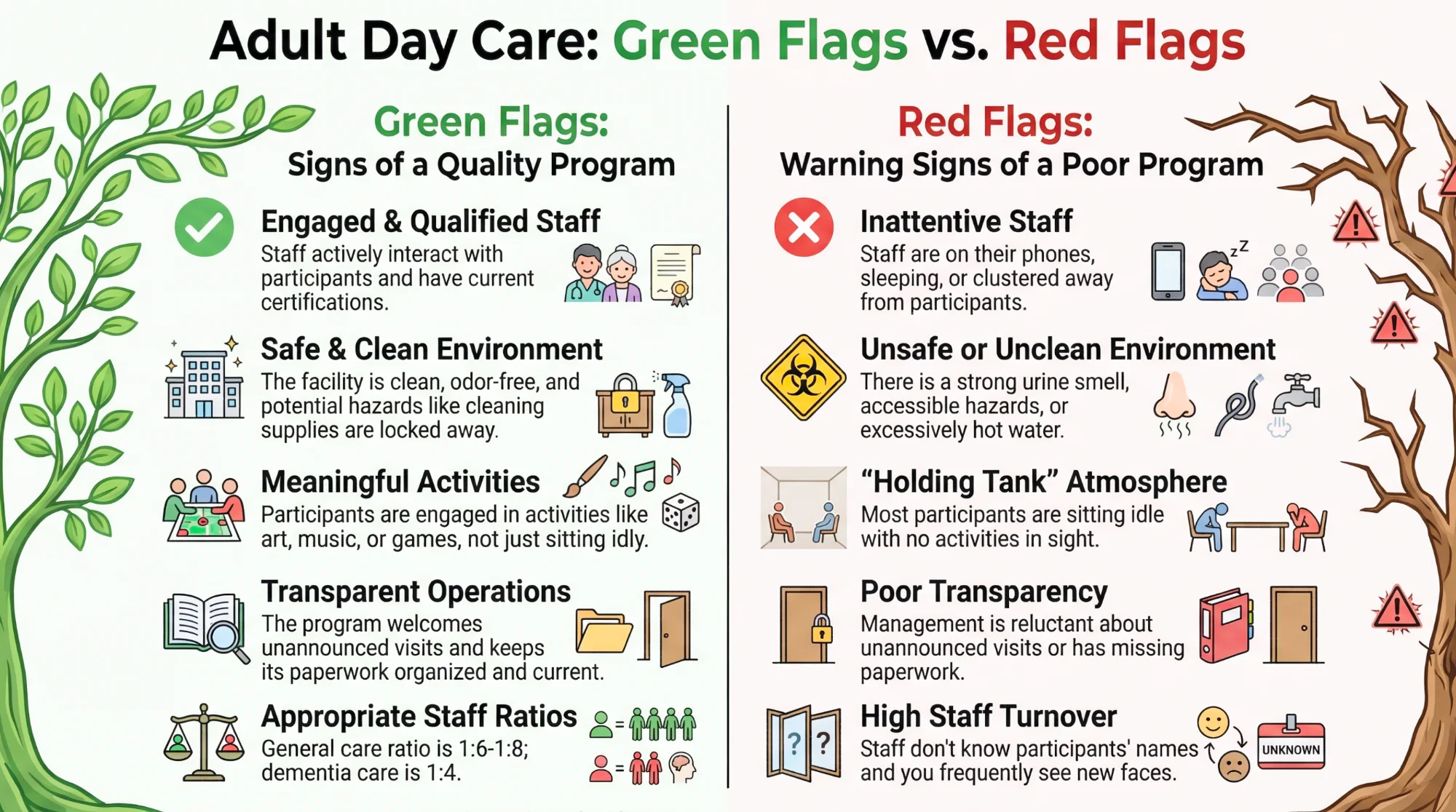
What to Look for on a Visit
Environment:
Clean, well-lit, and free of strong odors
Comfortable temperature
Activity supplies visible and in use
Secure if serving people who wander
Staff:
Actively engaging with participants—not clustered together or on phones
Addressing participants by name
Speaking respectfully, not dismissively
Adequate ratios (1:6 to 1:8 typical; 1:4 for dementia care)
Participants:
Appear comfortable and engaged
Actually doing activities (not just sitting)
Clean and appropriately dressed
Red flags (based on our analysis of California inspection reports):
Strong urine odor
Staff distracted or inattentive
Participants sitting with nothing to do
Cleaning supplies or medications left accessible
Reluctance to allow unannounced visits
Questions to Ask in Person
What happens if my loved one becomes incontinent?
What behaviors would result in discharge from the program?
What's your staff-to-participant ratio?
How do you handle medical emergencies?
Can I visit unannounced?
What training do your staff receive?
How will you communicate with me about how my loved one's day went?
Can we do a trial day?
Next Steps
If you've read this far, you're already doing the research—which is more than many overwhelmed caregivers manage.
Here's a path forward:
Figure out what you need. Hours, level of care, budget.
Check coverage options. Call Medicaid, PACE, VA, or your insurance.
Search for local centers. Eldercare Locator, NADSA, your Area Agency on Aging.
Call and ask questions. Narrow to 2-3 worth visiting.
Tour in person. Trust what you observe.
Try it. Most centers offer trial days.
Give it time. Adjustment takes weeks, not days.
Adult day care isn't giving up. It's not abandoning your loved one. It's getting professional support so you can sustain caregiving without destroying yourself in the process.
The research is clear: it helps them, and it helps you. Seeking help doesn't mean you've failed. It means you're being realistic about what one person can do.
This guide is for informational purposes only—not medical, legal, or financial advice. Talk to healthcare providers and local agencies for guidance specific to your situation.